I read The Fall of the Faculty a couple months ago, partially because it was cited in an ongoing discussion on our campus about what is to blame for higher educational costs. My general operating assumption is that of all influences on educational cost, cost disease has the biggest (and most relentless) impact. I was hoping The Fall of the Faculty would provide a strong counter-argument, but what it provided instead was an unsupported hypothesis — the costs are all the result of administrative bloat, brought on by a 1980’s takeover of the university by pointy-headed management types.
I was reminded of that reading Bowen’s excellent lecture on Cost Disease and higher education, especially when looking at this graph:
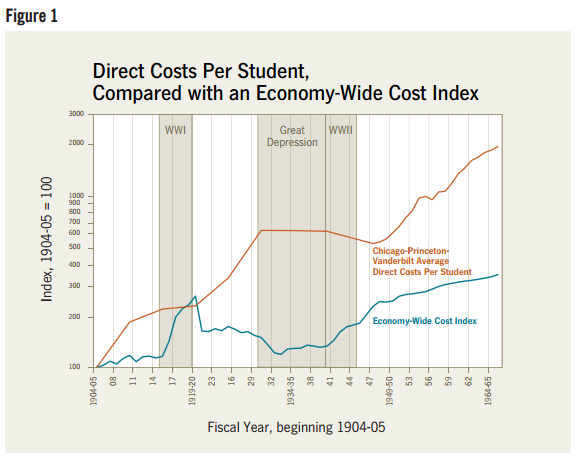
These are privates, of course, but if you look at the graph (which covers costs from 1905 to 1965) it’s pretty obvious that any theory of increasing educational cost that treats it as a recent phenomenon is seriously flawed.
Most attacks on the cost disease theory I’ve seen fail to deal with this fact at all. Conservatives want it to be Pell Grants distorting market efficiencies, whereas liberals want it to be the evil corporatization of the university (The Fall of the Faculty takes this to the extreme). It’s hard to look at this graph and see either of those explanations as sufficient.


 Hapgood
Leave a comment