
So I’ve been doing this Wikity thing for a while now. I use it as a personal learning environment.
When I learn something new, I try to capture it and connect it. This usually comes in stages. First, I’ll just capture some text, usually with the Wik-it bookmark (but sometimes with “Share to WordPress” when I’m on my phone).
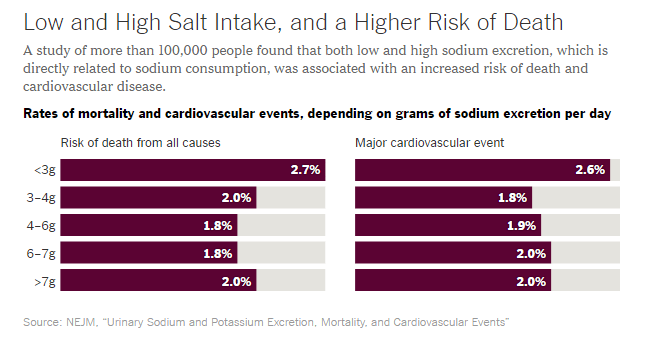
Here’s something I was reading at lunch about salt, arguing that low salt diets were as bad for you as high salt diets.
So I think of a name. The name is just a handle, like a variable name for an idea. Importantly, it’s not the name of the article I pull it from, but the name of the idea I’m pulling. (Multiple ideas might come from a single article).
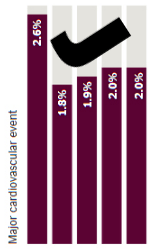
The idea here, or the pattern, is this response curve to salt. If you eat barely any salt, you have an increased risk of coronary issues. But if you eat a lot of salt, your risk increases too. Statistical patterns like this are often called “J-curves” because when they are plotted on line graphs, they often make a “leaning J”, like so.
I call this “Salt J-Curve” and post it to Wikity.
There’s a lot to just that process, in terms of learning. I’ve found the right paragraphs (I choose ones here that are less opinionated than the conclusion), I’ve given it a name. It takes maybe 30 seconds, but it’s an engaged thirty seconds.
I decide to improve the article. I add the graph and an introductory line. “Both low-salt and high-salt diets are correlated with increased mortality.”
Again, a small one minute thing, but the process of summarizing what the excerpt says in a sentence further solidifies my understanding. I hit back space a number of times before I get it right.

Finally, it’s connection time. As people familiar with the process know, rather than writing a judgment on the card, you try to find connections you can make to other cards.
Here’s a mockup I made of the card format a while ago: at the bottom you show connections to other cards (and explain the connection). I used to call these “references” but the point is the same. You must connect your new knowledge to your existing knowledge web.

Anatomy of a Wikity Card: Title, Abstract, Treatment, Related Cards and Pages
So back to salt. I need some references, and I know that J-curves are also associated with alcohol consumption. A drink a night is correlated with benefit, whereas both many drinks and no drinks tend to co-occur with bad health effects. I search on alcohol, with a vague memory of a card I wrote on those curves. (UPDATE: Responding to Kate’s comment, a lot of time I have no memory of any cards, in which case I just plug in related terms and see what comes up).
So I search “alcohol”.
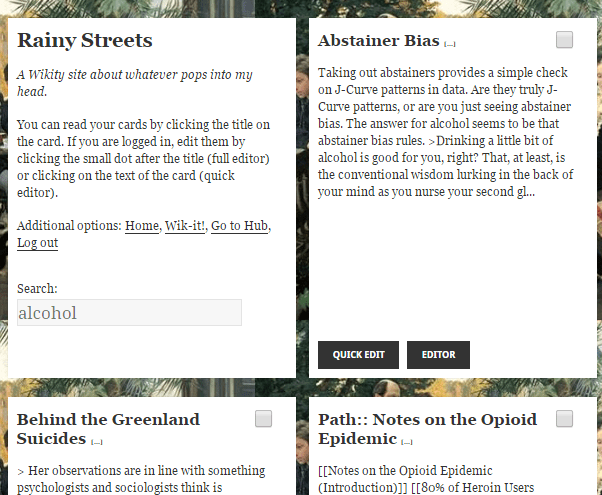
Hmmm. So here’s an issue.
I’ll see if I can explain it to you here. My “Abstainer Bias” alcohol card reminds me that the J-curve in alcohol is thought (by some) to be a result of the fact that abstainers are a very different population than infrequent drinkers. If you take a population that has a drink a week and one that has a drink a night they are going to be roughly comparable population. But _zero_ drinks, now that’s a special number. People doing zero drinks in our culture are generally doing zero drinks for a reason. It might be religious reasons. It might be health reasons. It might be they’re a former alcoholic. It might be that at an advanced age, they don’t handle it well any more.
So that curve in alcohol is likely not a cause-effect curve telling you to drink “just the right amount of alcohol” to get in the alcohol Goldilocks zone, it’s probably a normal dose-response curve where each bit of more alcohol = just slightly more death, no matter how much you drink. We know this, because if we take out people that abstain from alcohol entirely, the J-curve goes away.
This happens in my head in about three seconds, by the way. “Oh, right, abstainer bias!”
So if I want to make a link from Salt J-Curve to Abstainer Bias, what would it say? Can salt have an abstainer bias too? Let’s look at the chart again.
This is just a guess, or the fragment of an idea, but where would you expect people with high blood pressure to be? Well, I’d expect them to be two places on this graph. I’d expect the people with very high sodium intake to be have a lot of cases based on cause/effect.
But I’d also expect a lot of people with heart conditions and high blood pressure to be abstaining from salt, and would assume they cluster at the bottom.
So I write up a link at the bottom. “The J-curve here may be just another example of [[Abstainer Bias]]” and link to the card.
This process, beginning to end takes about 3-5 minutes. I’ve done it hundreds of times since November, and now have a library of stuff which produces neat connections about half the time I use it. It took a long time to get here, a lot of work, but I am not kidding when I say it’s a superpower. Or as I said to David Wiley a while back, “My main pitch for this thing is this — it’s made me smarter. A *lot* smarter.”
It does that by forcing me to suspend my reaction to things until I’ve summarized them and connected them to previous knowledge. It forces me to confront contradictions between new knowledge and previous knowledge, and see unexpected parallels across multiple domains. It forces me to constantly review, rehearse, revise, and update old knowledge.
What do other social media solutions do? They allow you to comment on it, to share it. They ask you to react immediately, preferably with a quick opinion. They push you to always look at the new — never connect or revisit the old. They treat your reaction — your feelings about the thing — as the center of your media universe.
Can any of this be good for learning? For empathy? For innovation?
Of course, doing it this Wikity way takes time. The more you put in your library, the more useful it gets, the more it feels — honestly– like a superpower. But I don’t know how to market that to a culture used to gratification on day one, I really don’t. And I don’t know how to explain the benefits of a product that generates insights that are complex, not simple. It’s a puzzle.
What I do know is that it continually teaches me surprising things, and forces me to question my judgment. As long as it’s doing that, I guess I have to keep trying to explain it.


 Hapgood

Leave a reply to CogDog Cancel reply