Renewable assignments, as defined by David Wiley, are assignments that don’t get thrown away at the end of the semester (disposable assignments), but rather live on because they engage in real-world problems. Christina Hendricks, in her treatment of this practice, provides some helpful examples:
Some instructors ask their students to write or edit articles on Wikipedia. See, e.g., Jon Beasley-Murray’s article on “Murder, Madness and Mayhem,” detailing what students in a Latin American Studies course at UBC did on Wikipedia.
Students in a Psychology course may be able to actually conduct a research project (rather than just planning one) and present their findings at a conference or in a publication of some kind.
Students in a History course may produce historical research about their local area with primary sources, that is then useful to community groups outside the university.
Students in Physics 101 at UBC, taught by Simon Bates, create learning objects (such as videos, power point slides, and diagrams) to help teach physics concepts to others.
Graduate students in a course on open education (taught by David Wiley) put together an Open Education Reader, a collection of readings on open education, with commentary. They released it as a free, open, online book that anyone with access to the internet can use.
Long-time readers here will know that renewable assignments are close to my heart, They were the basis of my first educational technology work, the topic of some of my first edublog posts, and it was issues with renewable assignments that led me to spend the last year and a half learning the secrets of federated wiki zen.
With that dedication, however, there has come some heartache. And it’s been caused by this weird dichotomy around collaborative work:
- Small class sites (such as wikis) have a hard time bootstrapping to something useful, and even when they do get there they start to rot right after finals.
- Large collaborative sites like Wikipedia make student work durable and provide a scaffold to build on, but require that the needs of the class bend to the needs of the site.
So on one side we have control, but the work you do has to start from scratch and begins to decay after finals.
And on the other side we have, well, Wikipedia. And I love the re-focus recently on writing Wikipedia articles as class assignments, but anyone who has worked in that space understands how much of your class must become about Wikipedia to do this. Additionally issues like notability adversely affect your class’s ability to cover niche issues, minority viewpoints, or items of only local significance.
But what if there was a way (I know I sound like an infomercial here) — what if there was a way for classes to build on the work of others while maintaining control of the direction and focus of their class? And what if instead of the work decaying at the end of the semester the work propagated and proliferated to other classrooms that could carry it forward? Classrooms that would keep it alive, and updated, and living?
The Federated Library Project
Let me outline a vision for you. You are teaching an economics class and looking to create a renewable assignment. You browse things in a massive library of student work called the Federated Library and you find this interesting article, written by a student in a sociology class.
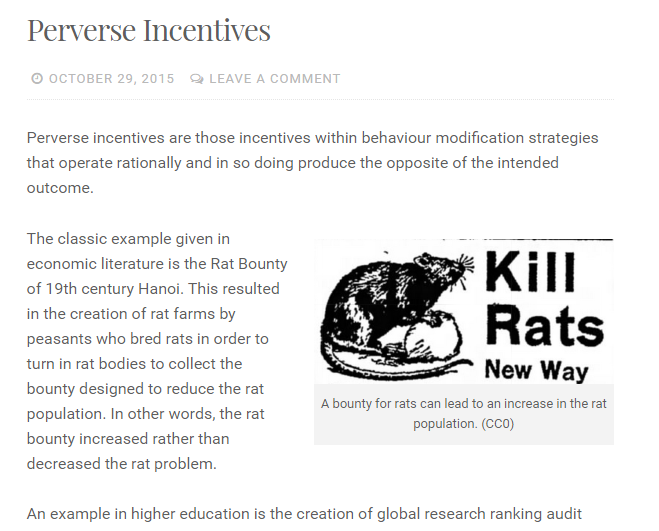
“Aha!” you exclaim, “I have got it!”
The article describes the effects of this weird market economy for rat tails in turn-of-20th-century Hanoi. A “rat bounty” for rat tails (designed to decrease the rat population) perversely led some enterprising locals to breed rats for their tails, and others to chop off rat tails while letting them live, all of which increased the rat population there.
There’s an economic model here that the students can build in Excel. Your class can set a “rat bounty”, a cost of breeding rats, the opportunity cost of breeding rats, the cost of catching rats, and see how playing with these variables changes rat production in Hanoi. What we want to do is get more insight into what this story is telling us. Along the way we learn the math of economics.
So here’s how you begin — you copy this page and a number of others into your class site. These are now the background to the assignment that the students have to read. You search the federation and find a decent explanation of how to create supply and demand models in Excel. You fork that in too.
Here’s the research question for the students: given a model they construct can a bounty be designed that works? (For instance, what if we introduce a fine for breeding rats to increase cost of breeding, etc.? What is the difference between a bounty for rat tails and a bounty for rats?)
They work through that question and produce an Excel spreadsheet that models the situation as well as a number of pages summarizing their findings and research.
And when they have that stuff together they post it up to the class site and link it to the materials you copied in from the sociology class. You’ve essentially used the sociology materials to bootstrap your economics site.
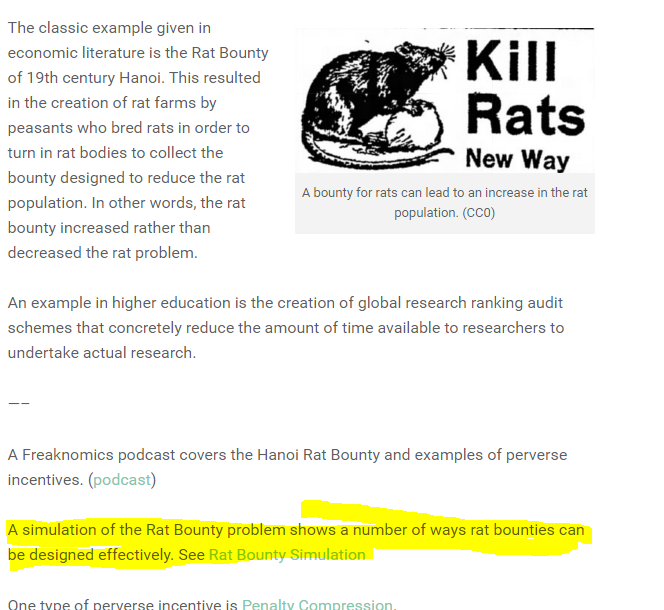
The story continues. A history professor browsing the federated library comes across this while thinking about local history. And she thinks — well, this is a weird story, because didn’t Portland also have a rat bounty at the turn of the century? And nothing like this happened, at least to her knowledge. So she adds a segment in her digital humanities inflected course where the students will research and write a history of public health issues in turn of the century Portland.
One of the pages her class creates is called Did the Portland Rat Bounty Work?
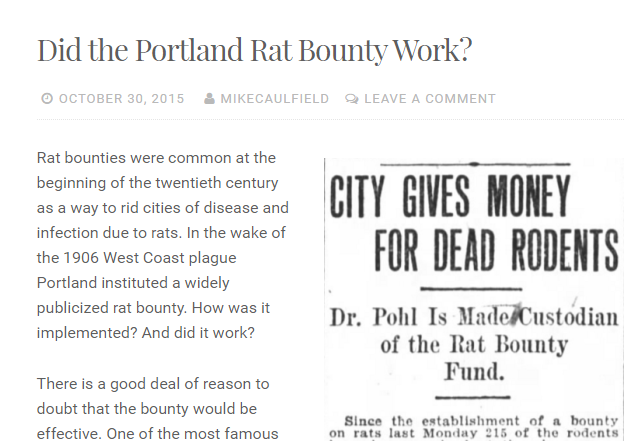
And it links at the bottom to the copied material from both the sociology class site and the economics class.
It also notes that the Hanoi rat bounty story seems to be derived from one administrative report written three decades after the event in French, and asks whether there is maybe a French class that could translate? Following a convention of the federation the page is tagged #french-translation-needed to make it easy for language teachers to find the assignment.
You see what has happened here? That sociology page about Perverse Incentives is on three individual sites now. Four, maybe, if it gets picked up by the french class. And as it moves through the network and proliferates it stays updated, and gets extended rather than dying a slow death on an abandoned class wiki. If the class wiki ever dies, the page survives.
More importantly, classes do important work by building off the work of students before them, And they do it all without ever having to coordinate with another class, or ask permission to post stuff on a wiki that someone else owns. They do this all in their own space, and allow the architecture of federation to make it possible.
(This is essentially the same vision outlined in Federated Education last year, but I’ve learned to be very explicit 😉 )
The Dream
It’s sometimes difficult to articulate why the architecture of federation is central to the success of this sort of initiative. The first impulse of people who haven’t lived through the past decade and a half of OER initiatives is “Wait, why don’t we just build a central site of student work!”. You don’t need federation at all, right? “You could make — a STUDENT WIKIPEDIA! Or, or, or — a central OER repository!”
(Pause for some lengthy #headdesk-ing)
I can’t compress the rationale for the architecture into this sort of space. Part of me just wants to say that look, I’ve walked through every nook-and-cranny of this problem over the past two years and federation is the only way this can work. Most of me knows that isn’t a good enough explanation.
But this workflow up above, where class builds on top of other class in a permissionless, fluid way? That’s the dream. That’s why a federated read/write architecture is worth it. That’s why it matters.
I’m working on this WordPress implementation of federation now, largely because Jim Groom is like the Bill Gates of edtech and #ReclaimSoft is populating the education landscape with thousands of WordPress servers. So I want those servers to be pointing at this mission.
I have zero idea how we’re going to build it really. It’s going to be a lot of weekends at the local coffeeshop I think, learning Javascript and the WordPress JSON API.
But this thing above? This dream of the fluid class-by-class extension of our collective knowledge and understanding? That’s why it’s worth it. That’s why it’s worth building right. That’s what makes federation as a model worth the effort to understand. And that’s why so many other initiatives right now just seem unexciting by comparison.


 Hapgood
Leave a comment