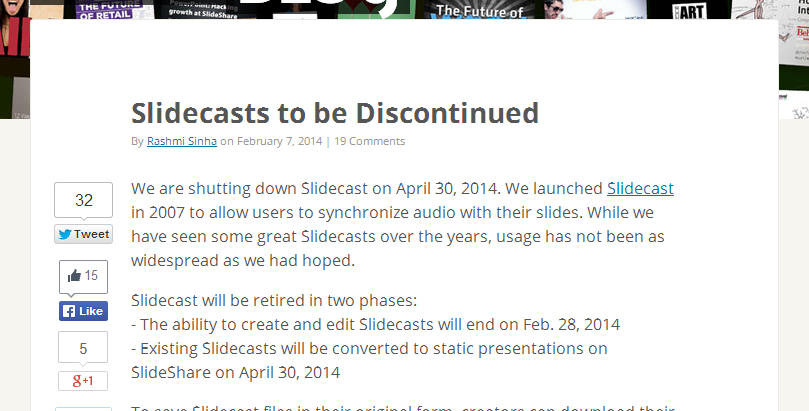
Slideshare has been good to me. Outside my surprise Latvian Top 40 hit, my “Slidecasts” (PowerPoints plus audio overlay) rank as some of my more popular productions. If the Slideshare analytics are to be believed, my combined presentations on Water 106 (I did a bunch) have been viewed collectively over 4,000 times. My presentation on Open Course Frameworks has another 1500 or so views.
But today I’m doing that all too familiar dance of “downloading my stuff before the third party service deletes it”. Slideshare is discontinuing Slidecasts, and has tossed my stuff out on the street for me to collect, in true rom-com breakup style.
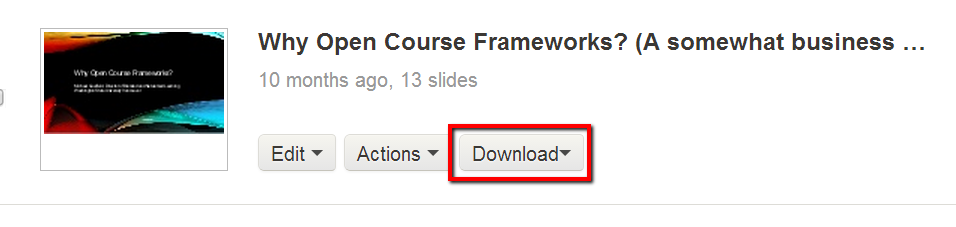
I’ve got to get them off the server by the end of the month. And by “get them off the server” I mean a seperate PPT file and audio file, which are not the Slidecast, but the materials I uploaded to create the Slidecast before a good hour of syncing markings.
Some might just sigh “capitalism” and leave it at that. But I don’t think it’s that.
Because we had a system, once, that mostly worked. It was based on a seperation of concerns. As an example, back in 1997 or so I bought a computer from HP and I bought a program from FutureWave Corporation called “FutureSplash”. I made flash-like animations with that program and saved them to my hard disk. When Macromedia bought out FutureSplash, renamed it to Flash and radically changed the format, I didn’t get a notice that said “Your files will no longer work.”
Everything continued to work. I could open them, edit them, work with them. Macromedia didn’t own my drive, or even (really) the instance of the program its predecessor had sold me. I didn’t have to worry that a TOS had changed and now my files could be mined for personal data or used in advertisements. And incentives were better aligned, as well upgraded to Macromedia Flash not because my stuff wouldn’t work without it, but because they had great new features. Imagine that — people paying money to upgrade not because someone had a gun to their head, but because paying that money allowed them to do new, neat things.
All that was capitalism, all that was companies, and all of it kinda-mostly worked.
For a while this changed, because we suddenly needed peresistently available web storage and browser-runnable apps. It made sense to push that all up to the server. And it made the coding easier as well, not having to write for all the different platforms. And suddenly the old system was gone — your files, hardware, and code were all controlled by the entity that handled your web display and bandwidth.
My point in previous posts about personal cyberinfrastructure is that one way out of this is everyone will have a server somewhere with open-source apps on it. And that may work. But the thing is I don’t think most people want to run their own server. I think they want to own what they buy, more or less forever. And I think they don’t want to be in thrall to a software subscription plan or shifting ToS just because they *don’t* run their own server. And the weird thing is that we had that, mostly.
The storage-neutral idea is just part of a seperation of concerns critique of this new paradigm. As we move away from browser-based software and back to apps that run at least partially on our devices, do we want to preserve the sort of vendor control that emerged in the web-as-middleware age? Or do we want to reintroduce the separations we lost?
Slideshare, ultimately, doesn’t spend any real money on my editing of these things or the storage of the files. Or even the editing software. But the bandwidth is killing their bottom line. So because the bandwidth is not separated from the service or the storage, everything must go.
That seems really broken to me, doesn’t it to you?


 Hapgood

Leave a reply to mikecaulfield Cancel reply