I came across this today:
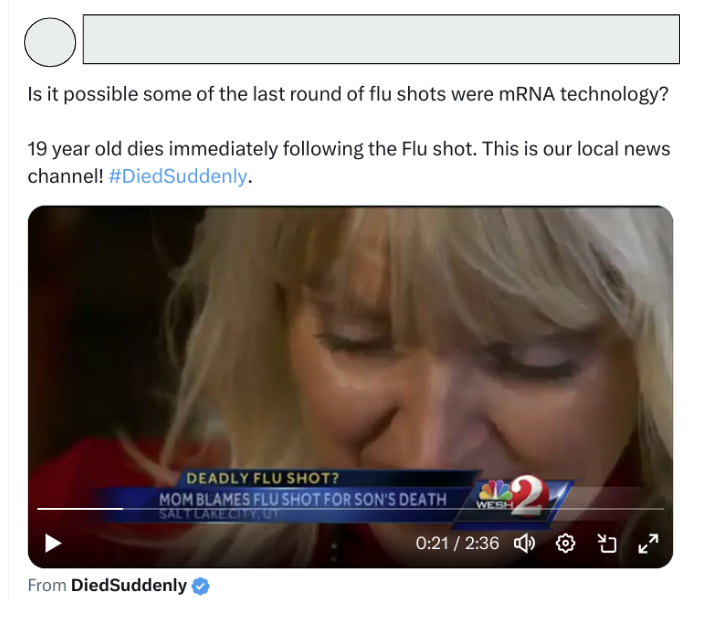
Ok, so yeah, as they say — there’s a lot going on here. We’re going to diagram it in a minute. But let’s start with the basics.
How open arguments work
In order to analyze this, you first have to realize it does not stand alone. It is part of an ongoing argument that is being constructed. The way that argument works is pretty simple. But let’s take a short detour and look at the structure of argument supported by examples.
Say I want to convince you that Sally is not a good realtor. We chose her as our realtor, but I think she’s not on top of things. You think she’s more or less OK. She sent us the wrong form yesterday. She returned one of our calls late, possibly ruining our chance to see a house in time to make an offer. When a house we had been interested in had it’s price drop, she didn’t think to notify us.
I make an argument to you that sounds more or less like this.
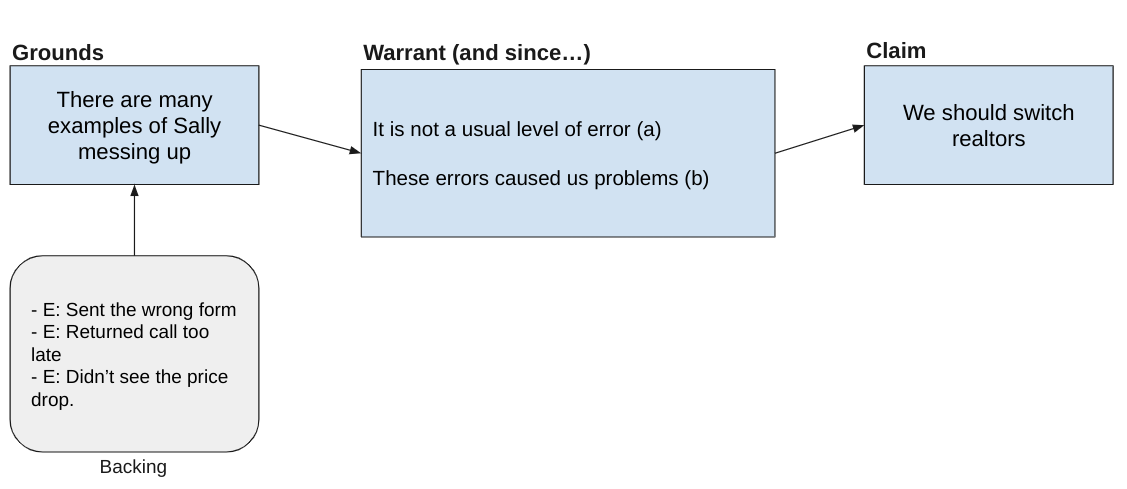
The structure is simple. My grounds is “Sally messes up a lot”. To support that I have many examples, here labeled “E” (for, you guessed it, examples). At some level and number of examples, the argument is pretty well grounded, provided that the examples match the warrant here, and aren’t a) usual errors, or b) errors with little impact.
Here, for “backing”, I map out the stuff I mentioned: she sent us the wrong form, she didn’t return a call of ours, making us late on getting an offer in. She didn’t seem to know about a house she should have known about.
Central to this sort of argument is the “warrant” that Sally is not just having the normal, expected level of error. That means the more examples I can come up with (and the more consequential the examples) the stronger the argument.
Of course, maybe I make this argument and you’re unimpressed. That’s a few things Sally got wrong, but so what?
As long as we still have Sally a a realtor, this argument is likely to go on for a bit. If we show up for a viewing, and Sally is 20 minutes late, I’m adding that to my list. If she shows up without the correct sell sheet, I’m trying to catch your eye, and say “see what I’m saying?”
I’m engaging in “evidence foraging” over time, trying to bolster my argument through the collection of additional examples. For someone that believes that Sally is incompetent, each example further solidifies or maintains that belief. For someone who thinks Sally is OK, each piece of evidence makes them a bit less sure of that.
The structure of the #DiedSuddenly argument
Hashtags on Twitter are often used in this similar way. In the case of #DiedSuddenly, the hashtag often identifies a submission into evidence. So the overall argument looks like this:

Like the Sally the Bad Realtor argument, it’s important to note that the person that advances an argument like this is not saying any single given piece of evidence proves the shot is deadly, any more than Sally being late once makes her a bad realtor. Each time a new piece of evidence is introduced the assertion is something more like “This new piece of evidence makes what I am arguing significantly more reasonable.”
Hence, the question isn’t whether the death of Marvin Hagler after a vaccination or the heart attack of a pilot proves the vaccine is deadly, but rather, do each of these events mentioned significantly increase the strength of the case that the vaccine is deadly. As we’ll see in a moment, the answer for the ones we’ve poked at is no. But it’s important to fairly characterize the argument all the same.
The specific example
OK, lets get to our specific example. As you’ll remember it was this:
And we can map this out like so:
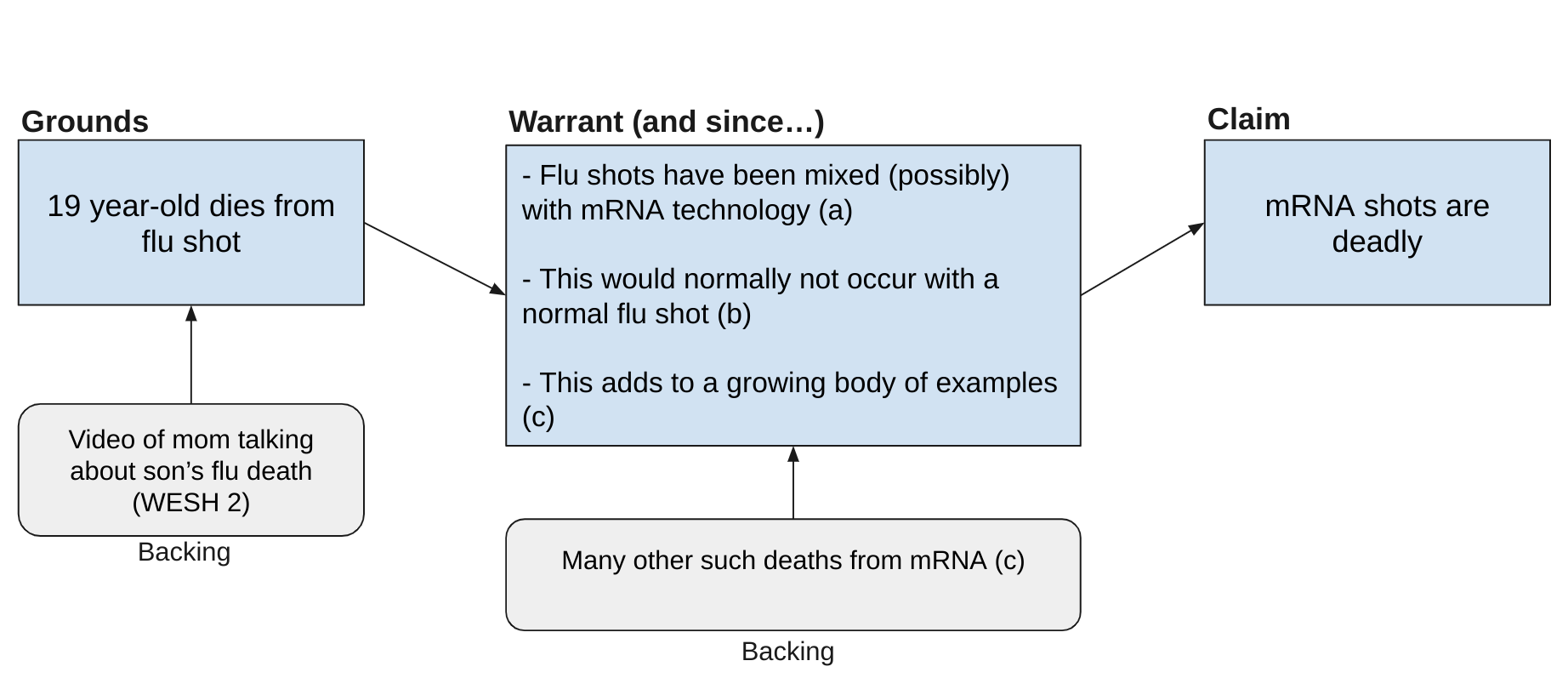
In this case, the video is reporting that acts as backing for the larger subclaim that a 19 year old died of a flu shot. That event supposedly adds to the “mounting evidence” that the mRNA shots are unsafe.
How does this argument fail? In a number of ways. But the most obvious is this: the story about the flu death is not recent – it is from 2011, a decade before mRNA shots were rolled out.
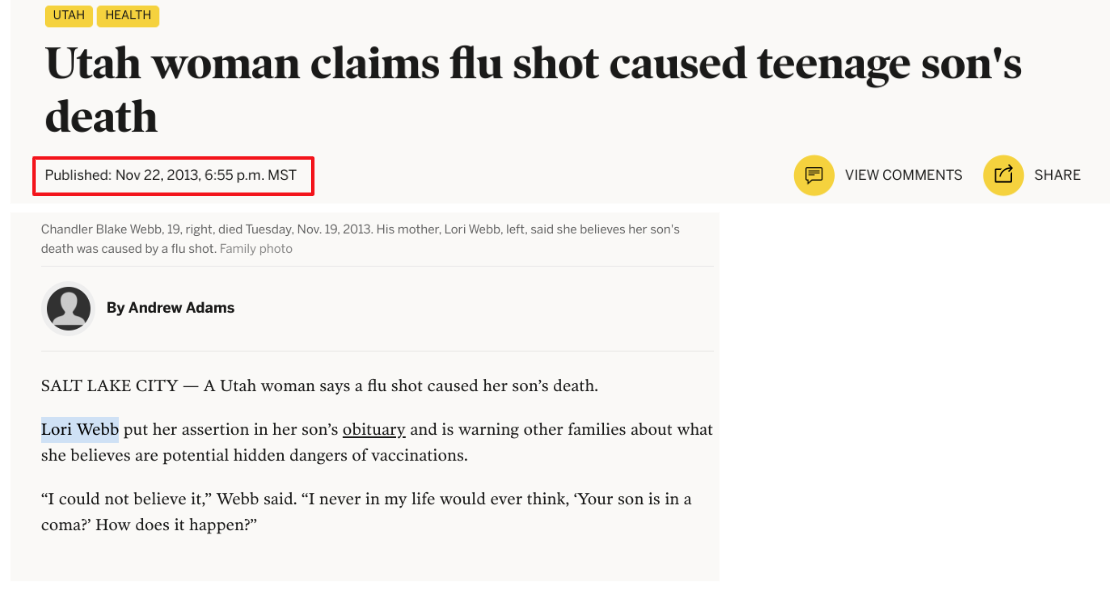
That’s probably all you need to know here — game, set, match, that’s a loss. But for the interested, the argument is wrong in another way. The news coverage of this event in 2011 highlights that the “death by flu shot” is simply a hypothesis of the mother of the person who died, one that is disputed by all the experts quoted in the piece. The news story doesn’t really support the idea that this is a death from a flu shot, never mind the the result of an mRNA shots that wouldn’t be available for another ten years.
We can note both these problems like so:
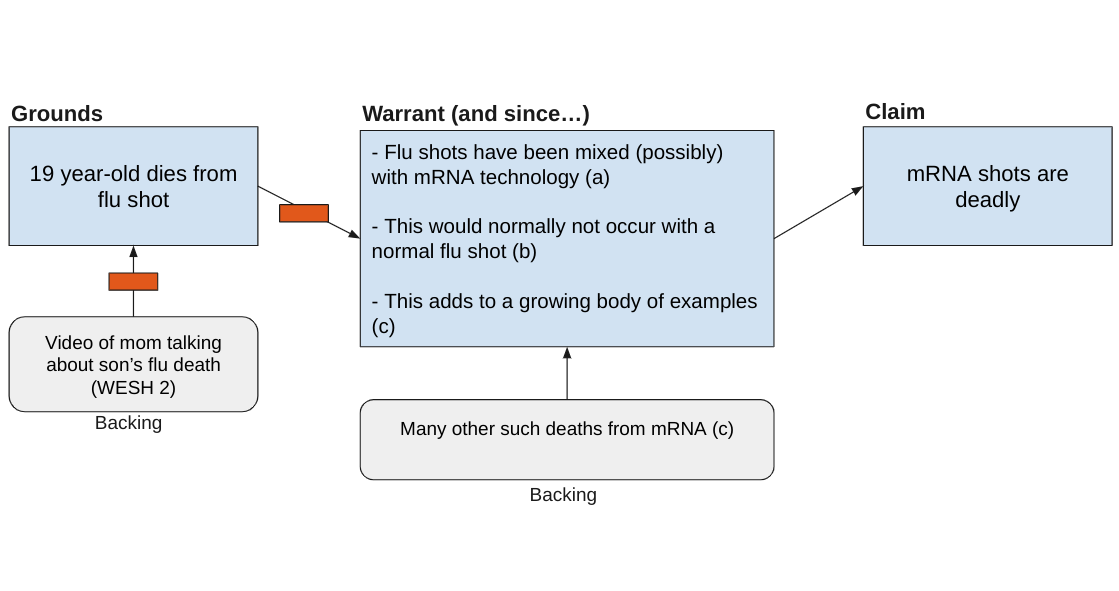
Finally, we come back to the fact that this argument is an incremental argument – that is, the person making this argument is not claiming that this death alone proves that the mRNA is a deadly vaccine. A with the realtor example, they are claiming that it adds to a growing body of evidence that this is a deadly vaccine.
And this is where it gets interesting. Because that “growing body of evidence”? It mostly looks like this example – events that are put forth as evidence of mRNA vaccine death, but when looked at even a bit more closely turn out to be misrepresented. What happens is each new one of these “#DiedSuddenly” incidents get uncritically accepted, and becomes backing for the argument that makes the next piece of weak or misrepresented evidence seem more meaningful or plausible. But nonsense built brick by brick is still nonsense.
This is perhaps the one area that is at least a bit harder of a call. It’s possible, of course, that someone could come up with some better backing for the idea that the sort of death proposed here is common, but from the perspective of the hashtag, I don’t see it.
In any case, we can note the following failures of the argument like so:
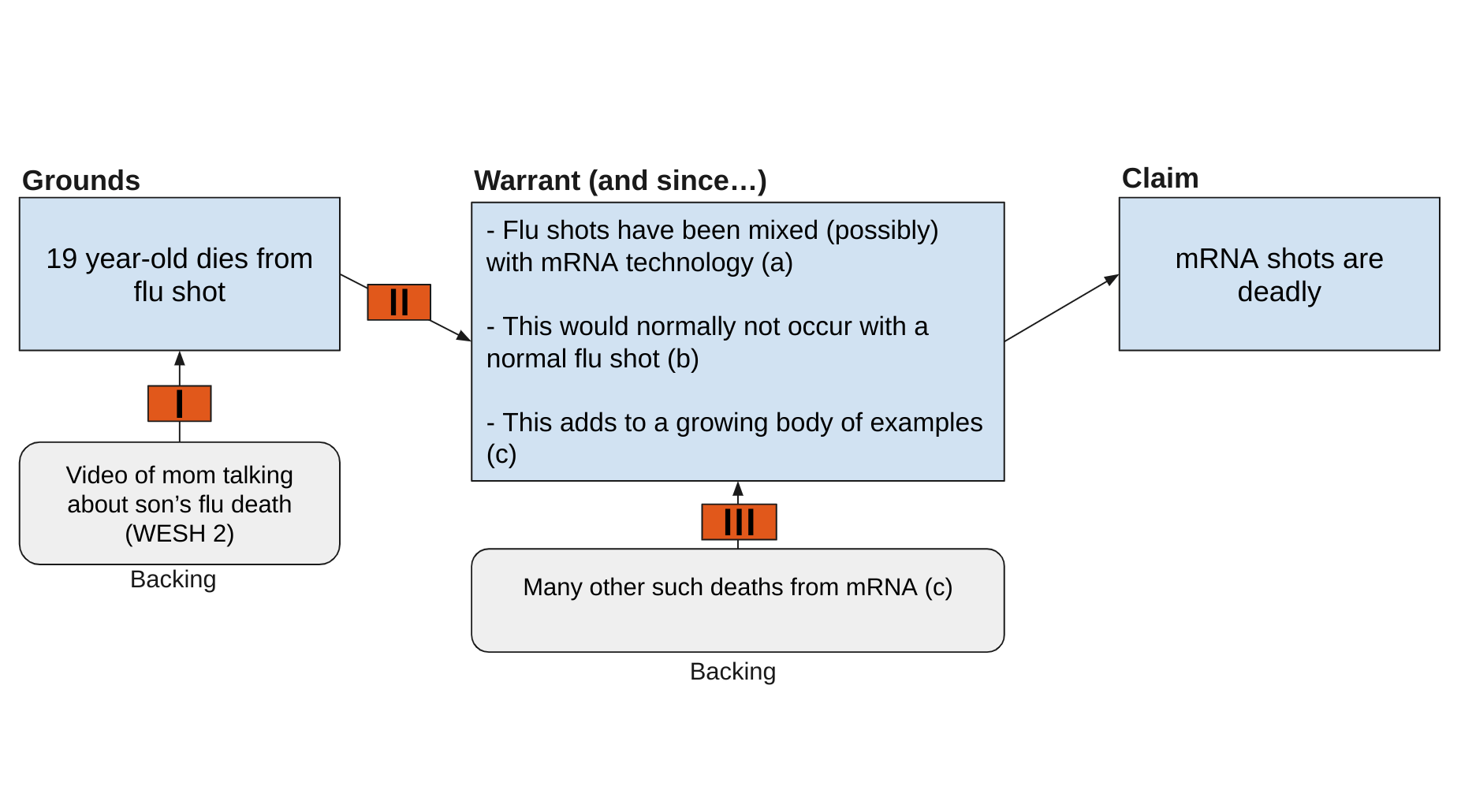
Key:
I: Video and associated news coverage does not support claim of vaccine death
II: Vaccine in example unrelated to mRNA technology, does not connect to warrant
III: No real evidence that this is part of a larger trend, at least as expressed here. There might, of course, be alternative backing not brought to bear here, but we’re unaware of it.
This post has been an exploratory post as I try to work through how to explain how modeling arguments using Toulmin’s methods can be instructive.

 Hapgood