Today in the New York Times, a Bari Weiss column links to an OFFICIAL ANTIFA ACCOUNT that calls gay man Dave Rubin an anti-LGBT fascist. This is supposed to prove, according to Weiss, that the Left is out of control:
Dave Rubin, a liberal commentator who favors abortion rights, opposes the death penalty and is married to a man, yet is denounced as an “Anti-L.G.B.T. fascist” and a “fascist lieutenant” for criticizing identity politics.
This links to explosive tweets that show how civility has declined and — as she points out — everyone is being called a fascist now by liberals. Shocking example cited:

And …
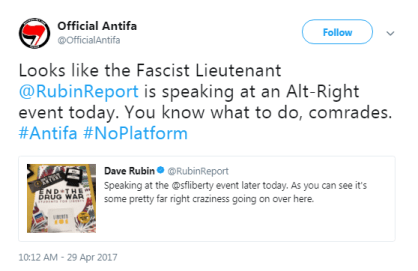
Linking to things people said on Twitter to prove a broad sociological point is pretty 2016, but the bigger problem is that the account she links to — from the pages of the New York Times — is a troll/hoax account. It’s a fake account designed to take in gullible readers and outrage them into spreading classic disinformation, stirring up hate against real antifa, either for political reasons or lulz or some combination of the two.
There are numerous ways you can guess that fact — the name “Official Antifa” being the first hint — but there is also a simple way to check this one: read laterally. So let me show NYT columnists visiting this blog a thirty-second maneuver that can prevent further ridicule and degradation of public discourse by hoax accounts. Here we go. It takes less than thirty seconds so pop your headphones in from the start or you’ll miss it:
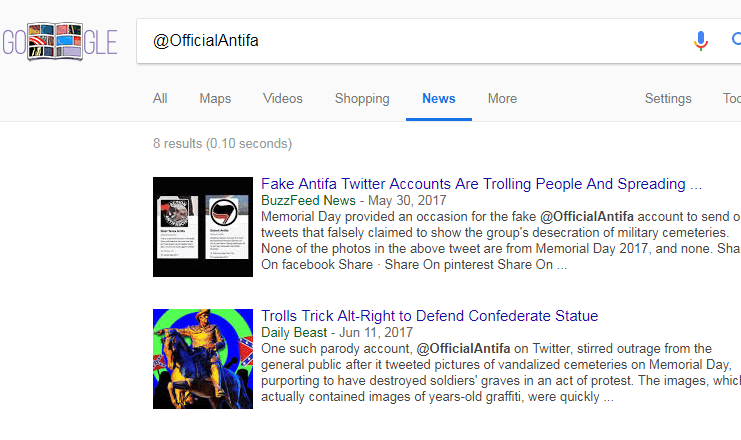
In this case, we select the Twitter handle, right-click to search on it, click the Google News tab to get a curated set of links/sources, and…
Actually that’s it. We’re done.
Now it’s not always this easy. Sometimes it takes a full minute, or 90 seconds. Occasionally it takes more than that and you have to use different, more complex methods. But it’s a pretty short process overall and one that you should be doing with every tweet you share, never mind ones you link to in the national newspaper of record.
We follow Sam Wineburg and Sarah McGrew’s groundbreaking media literacy research and call this technique reading laterally. It’s one of the four moves in the free eTextbook Web Literacy for Student Fact-Checkers, and a core technique in the online media literacy project we’re rolling out with the American Democracy Project, the Digital Polarization Initiative. Ninety-second fact-checks, based on new principles, that help students quickly verify and contextualize information.
I know I’ve written this glibly. Believe me, it’s because if I am not glib I’ll just get angry. This is work from the major national newspaper of record, not a gullible uncle posting on Facebook. And while Weiss claims to care about the disintegration of public discourse, she demonstrates the exact lack of care and skill that had led to it, allowing herself to be used, easily and fruitfully, by the crudest sort of manipulation.
The book is free. It’s about a two hour read. Please read it and stop linking to trolls.


 Hapgood
Leave a comment