Here’s the pattern for searches for “open textbook” searches on Google.
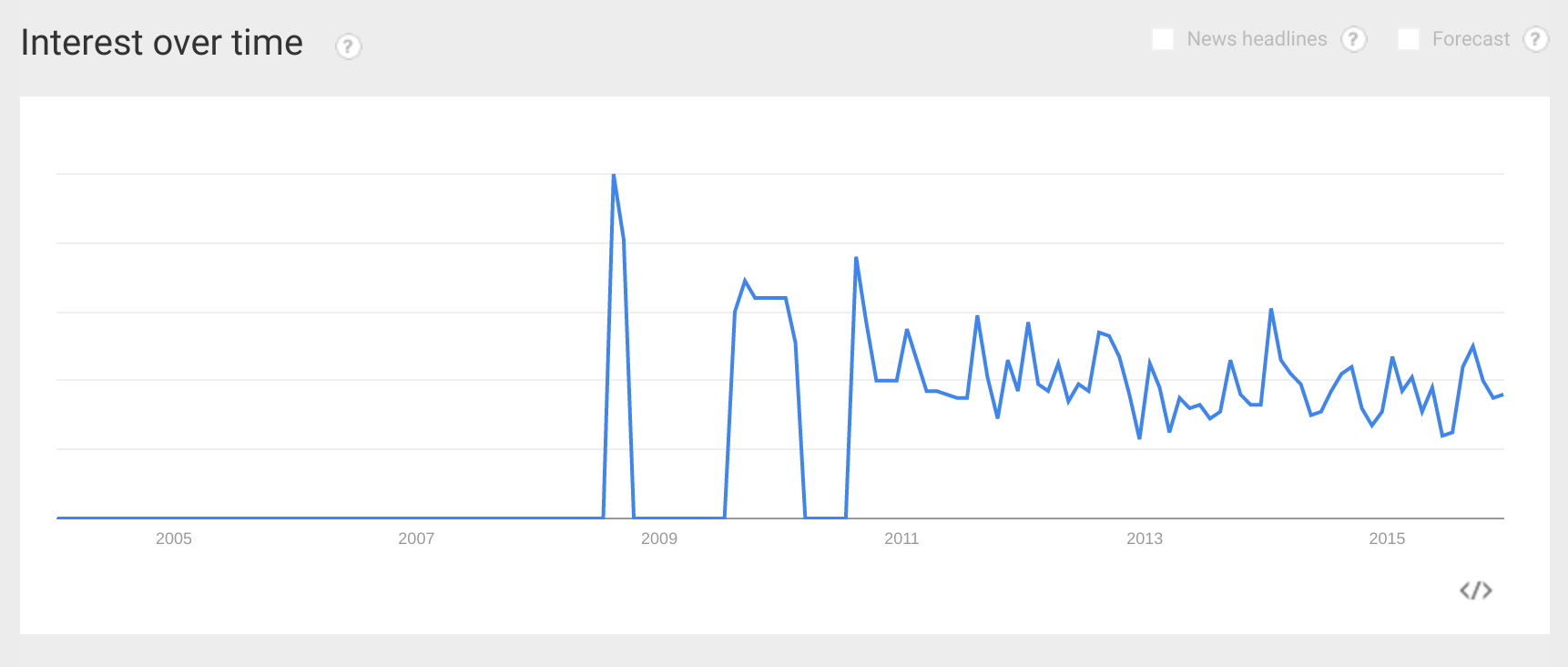
I just ran this out or curiosity a couple minutes ago. You’ll notice immediately that there is a cyclical pattern.
Click source up under the image to go and explore the graphic yourself, but the pattern is pretty easy to sum up. The high peaks are all August/September and January, months in which both the semester system and the quarter system launch courses. The slightly lower peaks are April, when the quarter system launches courses but the semester system does not.
This is interesting, because this is *not* the cycle you would expect if faculty were searching for open textbooks during a textbook selection process. In both the semester and quarter systems you’re generally locking in a textbook not at the beginning of a class, but during the previous registration period. For example, at WSU we lock in textbooks in Feb/Mar for the fall semester and November for the spring semester, and we do that, more or less, because it is both federal and state law that we have textbooks set at registration time.
It’s foolish to speculate too much on Google Trends data, especially on low frequency terms, but I just can’t help but imagine that this is an instructor looking for something in the couple weeks before a class.
The picture gets even weirder if you map out “open educational resources”. From my experience with faculty in my instructional design role, I’d expect to see a pattern where open resources are pulled during the first few weeks of the semester as the final holes in later weeks of the course are plugged. And we do see that — but what is surprising is the obviousness of the pattern:

It’s almost too perfect. The red line of OER here looks like the blue line has been shifted slightly to the right. When the course starts, we’re looking for open textbooks, but a few weeks into the course we’re desperate for OER.
Again, I can’t stress enough the dangers of reading narratives into trends like these. This is idle speculation at best.
But it sure is curious, right? And if true, there are some implications, I think, about how these materials might be designed…


 Hapgood
Leave a comment