Tim Klapdor has a good explanation of what the FedWiki Happening was and how it went on his site. For those that want to understand what all the fuss is about, that’s maybe a good place to start.
He also has one of the better lines of the week:
There are some idiosyncrasies to learn, some slightly odd concepts and practices but if you’ve ever driven a French car it’s nothing you can’t take in your stride.
Federated wiki, the Peugeot of social software! New tag line I guess.
But he says one thing I want to pick up on:
I’m kind of shocked at the flexility of Fedwiki as a tool. It’s really only limited by your imagination and I’m only just starting to get a sense of how it can be used.
This is the thing. When you first get your first generic Lego set and build the Millennium Falcon, it doesn’t really work as well as just buying the Millennium Falcon Lego set.

Setup is a pain in the butt. Things end up in weird places. It’s a bit funky looking.
But you start to realize after a while that, holy crap, I can build anything with this.
And that’s the case with Federated Wiki. It can be a hub for sensors. A film review application. A navigational database. Interactive fiction. A calorie counting application.
It’s not really a web site at all, or even web software. As Ward Cunningham puts it, it’s a new sort of browser embedded in your old sort of browser. It replaces HTML with JSON. It sees paragraphs/items as the atomic units of the web, not pages. It collapses the read/write distinction of the web, and replaces location-based networking with networking based on named objects. It introduces cross-page refactoring, which turns out to be a much bigger deal than you’d ever guess.
In many ways it resembles HyperCard, the missing link to the Web, a maker set for networked creation.
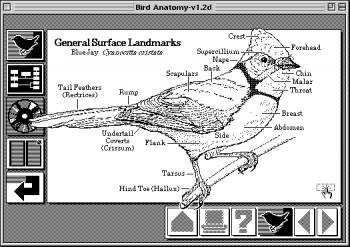
As the Ars Technica article linked above notes, the variety of uses of HyperCard in education were extraordinary:
- a stack of multiple choice test questions
- assembling, storing and delivering teaching materials that included graphs from Excel
- making class KeyNote-like presentations and handouts for students
- a calculator that included a variety of mathematical functions and graphing capabilities
- computer aided instruction in the sciences incorporating animation and sound
- fractals
- oil-spill modelling
- a database front-end to an Oracle database
- a database in toxicology
- selecting and playing tracks on a videodisk
- an interactive educational presentation showing jobs in the wool industry
- educational interactive games ‘Flowers of Crystal’ and ‘Granny’s Garden’
HyperCard even was the original platform the puzzle game Myst was programmed in. Myst remains one of the best selling computer games of all time.
It’s hard to see right now, but underneath the hood of Federated Wiki is some very careful thinking in how a few concepts — JSON, plugin architectures, dynamic neighborhoods, forking, pages as data sources to other pages — can be put together so that you can build applications without programmers.
(In fact, one of the joys of working with Ward has been when presented with a needed capability his question always is “How do we build a solution that gives users more creative power?” He’s iterative , but he rejects the incrementalism of the current age. If you want your users to do amazing things, they need the tools to get out in front of you).
So yes, it’s a bit of a Peugeot at the beginning. It’s not the fanciest Millennium Falcon on the lot. But in return you get a user innovation toolkit like no other. We may not talk about that much for the time being (I’ve found people get overwhelmed when I show everything Federated Wiki can do). But I saw Tim’s comment and could’t resist saying — you don’t know the half of it. 😉


 Hapgood
Leave a comment