So there’s not much subtlety in a recent comment on Jon Udell’s call to experiment with local weather data and look for trends. After reading Jon’s piece on using Many Eyes to determine local trends, Brendan Lane Larson, a Weather Informaticist, writes:
Your vague “we†combined with the demonstration of the Many Eyes site trivializes the process of evidence exploration and collaborative interpretation (community of practice? peer review?) with an American 1960s hippy-like grandiose dream of democratization of visualized data that doesn’t need to be democratized in the first place.
You may recognize this meme — it’s the experts vs. the amateurs story that’s being peddled by Andrew Keen and others. And like most people involved in Web 2.0 endeavors, I have some sympathy for that view, but despise the frame.
And reading Jon’s article and looking at that bar graph it occurred to me one thing that we consistently fail to mention in this discussion.
It’s not just Experts vs. Amateurs. It’s very often Experts vs. Experts in Something Else.
What do I mean? Look at this bar graph:
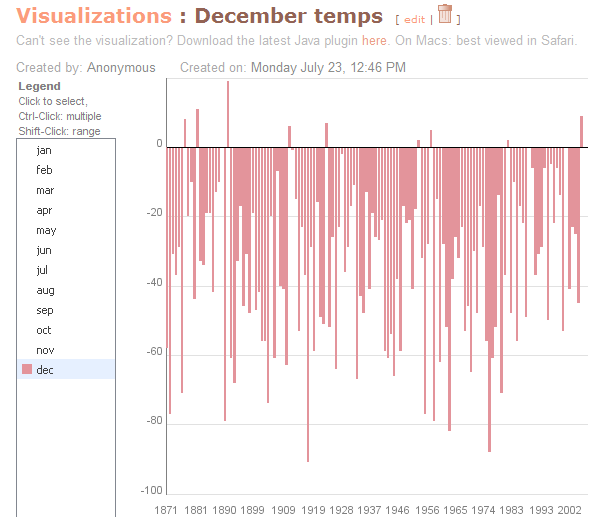
It’s temperature in December . And I know nothing about weather patterns.
But of course it doesn’t look like a temperature graph to me. It looks like the crazy graphs of server requests and thread lengths I’d pore over daily about two years ago when the server was crashing every couple of hours.
That’s probably not helpful insight in this instance, for a couple reasons. First of all, I’m far from expert in analyzing server and nework traffic. Second of all, temperature most likely doesn’t operate to rules similar to network traffic.
But what if I was an expert in analyzing network traffic? And what if, just possibly, I had models and methods unknown to the climatology crowd that could be helpful? Or what if I were a sociologist, or an options trader, or any other of a thousand professions that have developed ways to crunch data?
Could we admit that maybe, just maybe, experts in these other fields might bring a breakthrough to the table?
Think I’m wrong? The Wright Brothers were bicycle builders. The pair that cracked the DNA code weren’t biologists or chemists, at least not originally: they were an ex-physicist and a former ornithology student. Douglas Engelbart, inventor of hypertext and the computer mouse (among other things) was heavily influenced by the work of linguist Benjiman Lee Whorf. Mandelbrot revolutionized market analysis, without any economics background.
The list goes on. The world is not quite as bottled up into climatologists and computer scientists as one might like to think. Certainly we must establish distinctions when it comes to authority, and we must encourage peer-review and cultivate healthy communities of practice. But if we do all that while maintaining our xenophobia, we are ignoring an important lesson. One that history has taught us again and again.


 Hapgood
Leave a comment