I’m just back from some time off, and I’m feeling too lazy to finish reading the McGraw-Hill/Microsoft Open Learning announcement. Maybe someone could read it for me?
I can tell you where I stopped reading though. It was where I saw that the software was implemented as a “PowerPoint Plugin”.
Now, I think that the Office Mix Project is a step in the right direction in a lot of ways. It engages with people as creators. It creates a largely symmetric reading/authoring environment. It corrects the harmful trend of shipping “open” materials without a rich, fork-friendly environment to edit them in. (Here’s how you spot the person who has learned nothing in the past ten years about OER: they are shipping materials in PDF because it’s an “open” format).
The PowerPoint problem is that everything in that environment encourages you to create something impossible to reuse. Telling people to build for reuse in PowerPoint is like putting someone on a diet and then sending them to Chuck E. Cheese for lunch every day. Just look at this toolbar:
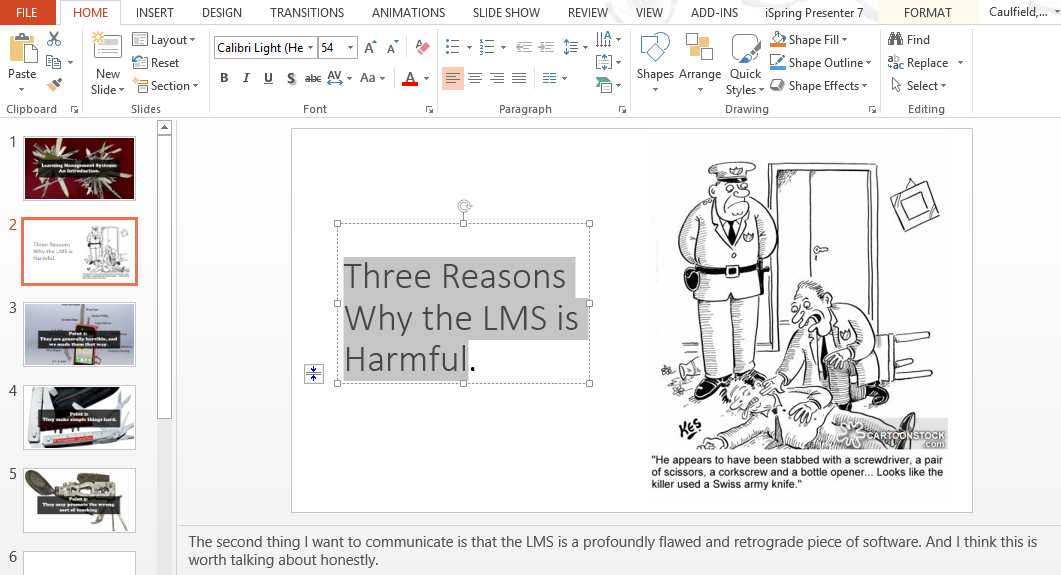
That toolbar is really a list of ways to make this content unusable by someone else. Bold stuff, position it in pixel-exact ways. Layer stuff on top of other stuff. Set your text alignment for each object individually. Choose a specific font and font-size that makes the layout work just right (let’s hope that font is on the next person’s computer!). Choose a text color to match the background of your slides, because all people wanting to reuse this slide will have the same color background as you. Mark it up, lay it out, draw shapes that don’t dynamically resize, shuffle the z-index of elements. Get the text-size perfect so that you can’t add or subtract a bullet point without the layout breaking.
Once you’re done making sure the only people who can reuse your document must use your PPT template, with your background, your custom font, and with roughly the same number of characters per slide, take it further! Make it even more unmixable by making sure that each slide is not understandable outside of the flow of it. Be sure to make the notes vague and minimal. In the end it doesn’t matter, because there is no way to link to individual slides anyway.
You get my point. Almost every tool on this interface is designed to “personalize” your slides. Create your brand. The idea is that this is a publication and you or your univesity’s stamp should be on it, indelibly.
Most things work like this, unfortunately, encouraging us to think of our resources in almost physical terms, as pieces of paper or slides for which there is only upside to precisely controlling their presentation. But that desire to control presentation is also a desire to control and limit context, and it makes our products as fragile and non-remixable as the paper and celluloid materials they attempt to emulate. We take fluid, re-usable data and objects, and then we freeze them into brittle data-poor layout, and then wonder why nothing ever gets reused.
So I love the idea of desktop-based OER tools, of symmetric editing and authoring. But there’s part of me that can’t help but feel that the “personal” in “personal publishing tools” has a more pernicious influence than we realize. It’s “personal” like a toothbrush, and toothbrushes do not get reused by others.
End of rant. Maybe I need a bit more sleep…


 Hapgood
Leave a comment